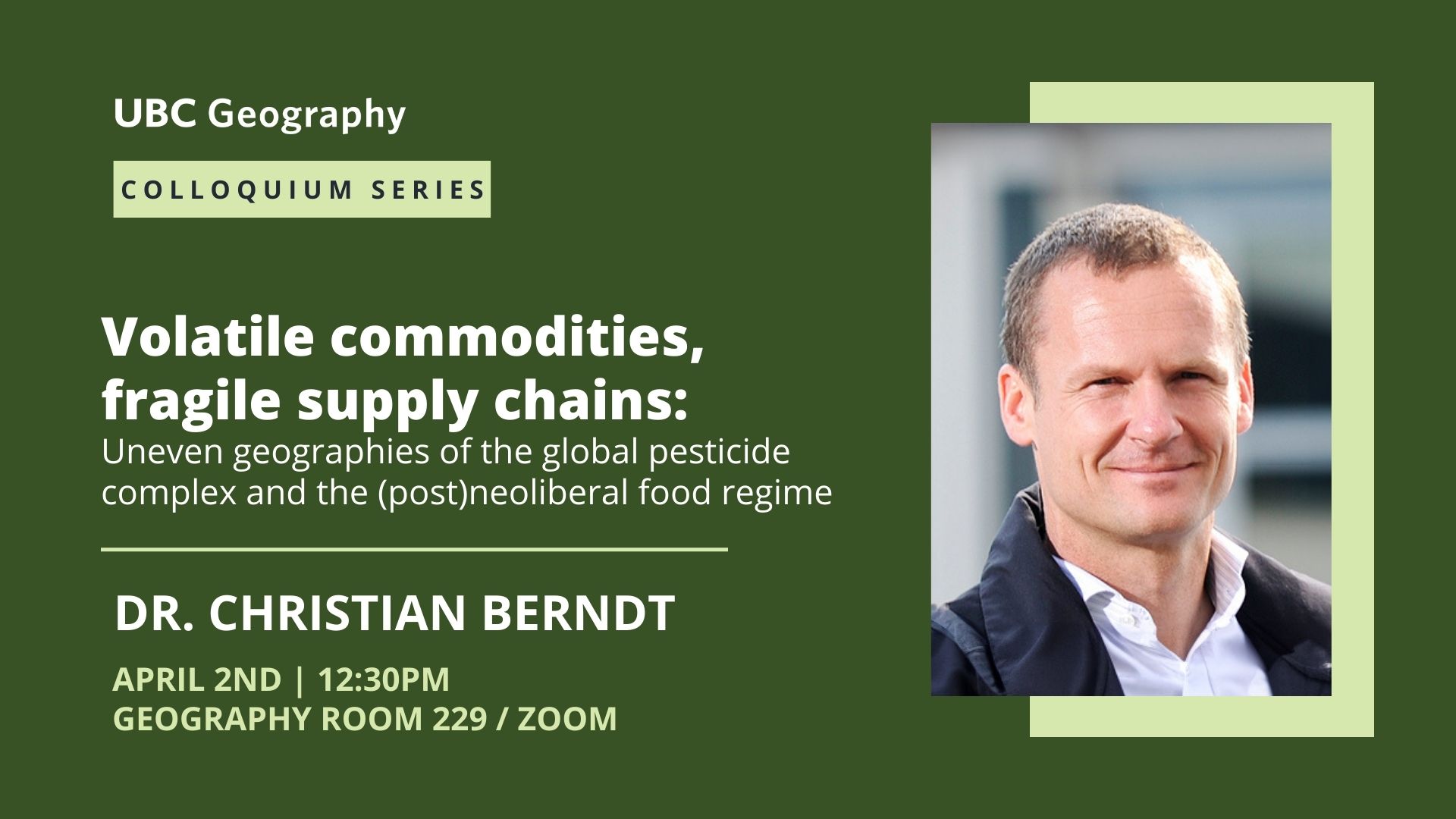
Speaker Bio:
Christian Berndt is
Professor of Economic Geography at the University of Zurich. Working at th
e crossroads of cultural economy and political economy\, his research focus
es on geographies of marketization and critical commodity chain studies. Mo
st recently he has engaged with the global pesticide complex\, agricultural
commodity markets\, social finance and behavioural economics and policy.
Talk Title:
Volatile commodities\, fragile suppl
y chains: Uneven geographies of the global pesticide complex and the (post)
neoliberal food regime
Abstract:
Agrochemical i
nputs have played a crucial role in underwriting a neoliberal food regime c
haracterized by the production of “more and more food with less and less la
bor”. The era of “cheap food”\, however\, appears to be over\, signaling a
food regime in crisis and challenging globalized industrial agriculture (Mo
ore 2015\; McMichael 2020). In this paper I join those who argue that claim
s for an imminent collapse of an agrifood system centered on “cheap food” a
re premature (Shattuck 2021\; Werner et al. 2022). This is most evident on
the terrain of agrochemical inputs\, above all pesticides\, where contradic
tory processes of biotechnological appropriation and substitution driven by
a multi-faceted agroindustrial complex complicate the picture. A generic r
evolution has significantly cheapened the costs of pesticides and massively
increased their availability globally. This did not translate into the pro
ductivity increases associated with earlier sociotechnical innovations. How
ever\, the rise of China and also India as key sites of pesticide synthesis
and formulation enables the continuous production of cheap food\, giving s
hape to an emerging neocolonial global regime facilitated by expansive “sou
th-south” pesticide supply chains.
In my paper I engage with these dy namics drawing on collaborative empirical research that links China with Ar gentina. An uneven division of labor emerges\, where Argentina is a highly intensive user of pesticides imported mainly from China to produce bulk com modities (mainly soy) that are to a large extent exported to China. Of cour se\, the global pesticide complex is confronted with limits and resistance. Geopolitical and geoeconomic risks disrupt supply chains and logistics\, p rices fluctuate wildly\, there are bans and restrictions\, chemicals behave strangely and nature’s resistance to active ingredients is a constant thre at. However\, rather than signaling the demise of neoliberal agroindustrial ization\, the Sino-Argentinian example demonstrates how the pesticide compl ex puts these challenges to productive use. Agrochemical capital generates new accumulation opportunities by mobilizing a logic of repair and a modern ist belief in technological fixes. It is precisely these contradictory enta nglements that illustrate the limits to imaginations of agrochemical intens ive agriculture as either in terminal crisis or capable of endless technolo gical fixes (Werner et al. 2022).
References:
M
cMichael P (2020) Does China’s ‘going out’ strategy prefigure a new food re
gime? The Journal of Peasant Studies 47(1). Routledge: 116–154.
Moore JW (2015) Capitalism in the Web of Life: Ecology and the Accumulation of C apital. New York: Verso.
Shattuck A (2021) Generic\, growing\, green? : The changing political economy of the global pesticide complex. The Journ al of Peasant Studies 48(2): 231–253.
Werner M\, Berndt C and Mansfie ld B (2022) The Glyphosate Assemblage: Herbicides\, Uneven Development\, an d Chemical Geographies of Ubiquity. Annals of the American Association of G eographers 112(1): 19–35.
This is hybrid event hosted in Geog 229 and on zoom. No registration required for in person attendance.
[buttons][button link_text="Zoom link" link_url="https:// ubc.zoom.us/j/68771652344?pwd=eVRwOFJuZHJocGJrVitEN3MwNjlJQT09"][/buttons]< /p> CATEGORIES:Featured Events LOCATION:Geography building GEO:49.266015;-123.256221 URL;VALUE=URI:https://geog.ubc.ca/events/event/colloquium-with-dr-christian -berndt/ ATTACH;FMTTYPE=image/jpeg:https://geog.cms.arts.ubc.ca/wp-content/uploads/sites/26/2024/03/Christian-Berndt-Colloquium-Talk-–-April-2nd-X.jpg END:VEVENT BEGIN:VTIMEZONE TZID:America/Vancouver BEGIN:DAYLIGHT TZOFFSETFROM:-0800 TZOFFSETTO:-0700 DTSTART:20240310T100000 TZNAME:PDT END:DAYLIGHT END:VTIMEZONE END:VCALENDAR